
Nobody Built the Operating System for the Business of Healthcare. So They Did.
Narrative Authenticity Framework Series | Analysis No. 44

In 2021, Tim Hwang and Jonathan Chen were still under COVID social distancing rules.
They had known each other since elementary school. They had built FiscalNote together, taking it from a DC apartment to a company with 5,000-plus customers, 900-plus employees, and a public market valuation of $1.3 billion. Healthcare represented roughly a quarter of FiscalNote’s customers, and building vertical SaaS for lawyers and government agencies had given both founders front-row seats to what it looked like when regulated industries tried to modernize.
What they saw in healthcare was specific: “the operational pain was obvious, the spend was massive, and the underlying infrastructure still felt years behind where it should have been.”
So they started walking.
Four hours a day, from Crystal City in Virginia through the National Mall in Washington. They talked about the pandemic and what it had revealed about healthcare infrastructure. They talked about the $5.9 trillion Americans spend on healthcare annually, an amount so staggering that if American healthcare were a country, it would rank as the third-largest GDP on earth, ahead of Germany, Japan, and India. And they kept returning to the same observation: the largest industry in America had some of the most advanced clinical technology in the world and some of the most fragmented business infrastructure of any major industry.
Nobody had built an operating system for the business of healthcare.
So they built Nitra.
Jonathan Chen, now President, described the founding problem with the precision that comes from having seen it from the customer side for years. A prominent plastic surgeon in Palm Beach, managing a busy practice, is not only delivering care. He is hiring and managing staff, scheduling patients, processing insurance claims, purchasing supplies, paying vendors, managing expenses, and reconciling accounts across six disconnected systems. The connective tissue between those systems is a person manually entering information, reconciling records, or chasing down mistakes.
A missed supply order delays a procedure. A delay in eligibility checks frustrates a patient. A coding or accounting error creates downstream financial stress. These are not edge cases. They are the daily operational reality of more than 500,000 clinics and practices delivering care on the front lines of American healthcare.
On March 10, 2026, Nitra announced $187 million in financing and a milestone: $1 billion in annualized processing volume across 700-plus practices and 2,500-plus physicians. Revenue grew 740 percent in 2025 to $33 million-plus on an annualized basis. Dr. Richard Park, the founder of CityMD, one of the largest urgent care groups in the country, joined the board.
I ran Nitra through my four-component Narrative Authenticity Framework. It scores 7.6 overall. The friction is named with unusual clarity and emotional specificity for a B2B fintech company. The lived stake is practitioner-derived in a genuine, specific form: not personal experience as a patient, but years of selling software to healthcare organizations and watching their operational infrastructure from within the customer relationship. The qualification is growing fast and validated externally by both commercial metrics and the CityMD founder’s endorsement. The aspiration is where the most important work remains: a claim about what changes for patients when the business of care is no longer held together by spreadsheets and 1-800 sales reps has not yet become the primary brand statement.
All facts verified against primary sources.
The Framework
I score companies on four components, each out of 10:
Friction names the problem everyone feels but nobody has fixed.
Lived Stake measures authentic proximity to that problem. Did the founders live inside it, or observe it from the outside?
Distinctive Qualification identifies the structural insight or non-obvious advantage that makes this company the right one to solve it.
Real Aspiration describes the specific transformed future state the company is building toward. Not a mission statement. A world that actually changes.
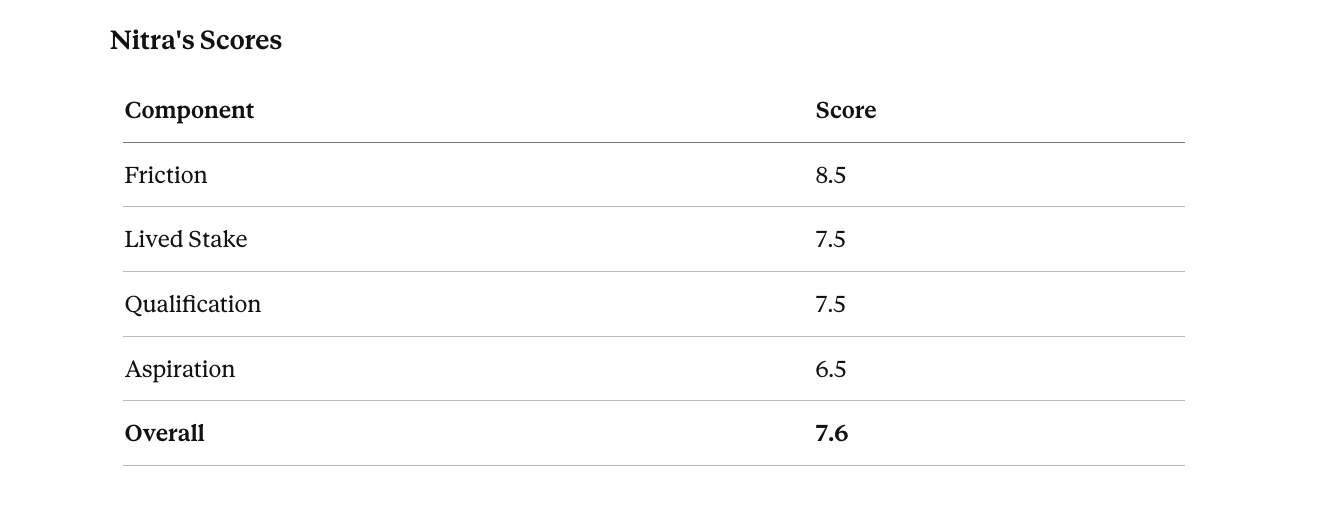
Friction: 8.5
The friction Nitra names has a specific quality that most B2B fintech companies fail to achieve: it is emotionally legible to people who are not accountants.
The LinkedIn post that named it best came from Nitra itself: “Why does the largest industry in America still run on fax machines, spreadsheets, and 1-800 sales reps?”
That sentence earns attention precisely because the contrast is so specific and so absurd.
The industry that performs neurosurgery, gene therapy, and robotic-assisted procedures is reconciling its accounts through manual data entry. The physician who just spent eight hours in an operating room goes home to a practice stitched together by phone calls and paper invoices. The surgeon is elite. The back office is 1985.
The founder story names the structural root cause at the level that earns the highest friction scores in this series: the problem is not that healthcare practices lack ambition to modernize. It is that the software built for healthcare was designed to document care, diagnose care, bill for care, or store records about care. Very little was built to run the business of care.
That distinction is the founding insight.
Healthcare has clinical software everywhere. It has almost no business operating system. The EHR manages patient records. The practice management software handles scheduling. The billing system handles claims. The bank handles payments. The distributor handles supplies. None of these systems was designed to work together, and the connective tissue between them is a practice administrator manually reconciling five different dashboards at the end of every day.
The scale of the friction is verifiable and growing.
Americans will spend an estimated $5.9 trillion on healthcare in 2026. The industry is the largest employer in the country. A meaningful portion of that $5.9 trillion flows through operational processes that are genuinely inefficient: overstocking and shortages in medical supplies because procurement is done by phone, delayed procedures because eligibility verification was not completed on time, and financial stress from billing errors that accumulate undetected across disconnected systems.
The Nitra founder story articulates the most visceral version of the friction with a specific scenario: “A missed supply order can delay a procedure. A delay in eligibility checks can frustrate a patient. A coding or accounting error can create downstream financial stress.” Each example directly links the operational failure to the patient experience. The supply management problem is not an accounting problem. It is a patient problem.
The score is 8.5 because the friction is specific, emotionally connected to the patient outcome rather than just the administrative burden, structurally grounded in the gap between clinical sophistication and business infrastructure, and named with more visual clarity than most healthcare fintech companies achieve. The score does not reach 9.0 because the vertical fintech and healthcare operations space is crowded with companies that name variations on the same fragmentation problem.
Lived Stake: 7.5
Hwang and Chen’s lived stake is practitioner-derived through customer proximity rather than personal experience of the friction.
The FiscalNote chapter is the key. They spent a decade building vertical SaaS for lawyers and government agencies, and healthcare represented roughly a quarter of their customers. That means years of watching how regulated industries respond to software adoption, where the value gets embedded and where it gets rejected, what makes a healthcare organization trust a new platform, and what makes them abandon it. The operational patterns of healthcare practices were not theoretical for Nitra’s founders. They had been inside them as a software vendor.
Hwang’s own background adds texture. He studied politics at Princeton and, as a student, engaged in debates about the Affordable Care Act, which gave him an early orientation toward healthcare policy as a structural challenge rather than a technical one. That political formation shaped the founding conviction: the problem with healthcare infrastructure is not primarily a technology problem. It is a coordination problem that technology can solve.
The National Mall walks are the founding stake’s most specific and most human element. Four hours a day, during a pandemic that had just revealed to the entire country what healthcare infrastructure looked like under pressure. The PPE shortages, the supply chain failures, and the vaccine logistics challenges of 2020 and 2021: all were operational problems, not clinical ones. The clinical capabilities existed. The operational infrastructure could not scale to meet the demand. Hwang and Chen watched this happen and concluded that the healthcare system’s operational infrastructure was the specific problem worth spending the next decade solving.
The score is 7.5 because the lived stake is genuine, practitioner-derived, and historically specific in a way that earns the founding conviction. The score does not reach 8.0 or higher because Hwang and Chen experienced the healthcare operational problem as software vendors observing their customers, not as physicians, practice administrators, or patients experiencing the operational friction personally. The FiscalNote customer relationship is real and informative. It is not the same as building and running a medical practice.
Qualification: 7.5
Nitra’s qualification is built on three compounding assets: the FiscalNote operational learning, the commercial validation of the current metrics, and the strategic advisory relationship with one of the most credible practitioners in American healthcare.
The FiscalNote foundation is the structural qualification that competitors building from scratch cannot replicate. Five years of building vertical SaaS for regulated industries taught Hwang and Chen specific things about healthcare software adoption that informed Nitra’s product architecture: where embedding creates stickiness, where integration complexity becomes a deployment barrier, how regulated industries evaluate new vendors and when they trust them. The platform approach, financial rails first, then software layers, then AI automation, reflects the sequenced embedding strategy of a team that has watched healthcare organizations adopt software and knows where the trust has to be built before the depth of embedding can increase.
The commercial validation is the qualification made empirical. $1 billion in annualized processing volume across 700-plus practices and 2,500-plus physicians. Revenue growing 740 percent in 2025 to $33 million-plus annualized. $9 million of biopharma and surgical supplies processed in a single day. These are not early product metrics. They are the commercial indicators of a platform that has crossed the threshold from useful to embedded.
The CityMD board appointment is the most specific external validation in Nitra’s history. Richard Park built CityMD from a single urgent care location into one of the largest urgent care chains in the country, and eventually sold it to Mount Sinai for a reported $600 million. He understands healthcare practice operations from the inside, at scale, across hundreds of locations. His decision to join the Nitra board is not a celebrity endorsement. It is the judgment of a practitioner who has managed the operational infrastructure problems Nitra was built to solve, and who concluded the platform is worth backing with his name.
The investor base adds depth to the qualification: a16z and NEA led the original round, with Tim Hwang as board chair and former FiscalNote co-founder bringing institutional knowledge of vertical SaaS scaling. The March 2026 $187 million financing, which included debt from multiple institutional sources, reflects lenders’ confidence in the platform’s receivables and transaction flow.
The score is 7.5 because the qualification is strong and growing, but still mid-stage. The platform has proven that healthcare practices adopt it, embed it, and transact through it at a meaningful scale. What remains to be demonstrated is whether Nitra can hold and expand those relationships at the complexity levels of larger health systems, and whether the procurement and AI agent layers it is building can sustain the embedded advantage against better-resourced competitors.
Aspiration: 6.5
Nitra has named its aspiration in two forms. One is a product description. The other is a belief about what American healthcare becomes when the business of care is no longer the constraint on the quality of care.
The product description is clear and consistently deployed: “the AI-native operating system for healthcare practices.” That is a category claim. It names the platform’s ambition without naming the world that exists when the platform succeeds.
The belief is present in the founder story, but has not been assembled as the consistent primary brand statement. The founder story names it with specificity: when Nitra is fully embedded in a practice’s operations, the practice can “anticipate supply needs from procedures, patient volume, and history, preventing shortages, overstocking, and triggering smart reorders for the best price on an automated basis.” That is the operational aspiration made concrete. The physician who previously spent twenty minutes on hold with a pharmaceutical distributor now has a system that placed the reorder automatically three days before the shortage would have occurred.
The patient-facing consequence is the aspiration’s most consequential and least-deployed dimension. The supply management problem is a patient problem. The delay in eligibility verification is a patient problem. The billing error that creates downstream financial stress affects the patient relationship. When Nitra’s platform removes those operational failures from the practice’s daily experience, the physician has more time and attention for the patient. The aspiration is not “AI operating system for healthcare.” It is: the doctor who just spent eight hours in surgery should not also spend an hour reconciling a procurement invoice. The technology exists to handle the invoice. The surgeon should be focused on the next patient.
Hwang named the aspiration’s most personal version in the founder story: “We are building the AI infrastructure for the business of healthcare.” The phrase “business of healthcare” is doing significant work. It names the specific layer, distinct from clinical care, distinct from insurance, distinct from pharmaceutical development, that Nitra has identified as its specific mandate. Nobody built the operating system for that layer. Nitra is building it.
The score is 6.5 because the aspiration is present and partially named, and has not been assembled as the primary statement that leads all external communications. The claim “AI-native operating system” is accurate. The specific world it enables, where the business failures of healthcare practices stop showing up in patient experience, is the aspiration that earns emotional resonance and is available to be named.
The Central Opportunity: When Business Failures Stop Reaching the Patient
The aspiration Nitra has not yet fully deployed is the most emotionally resonant available in the healthcare operations category.
The clinical technology in American healthcare is extraordinary. Robotic surgery. Gene therapy. Real-time imaging. The physicians delivering that care are among the most skilled professionals in any field. The business infrastructure supporting the delivery of that care, by the founders’ own description, is still running on fax machines, spreadsheets, and 1-800 sales reps.
That gap has consequences that are not primarily financial. A missed supply order delays a procedure. A delayed eligibility check frustrates a patient who drove forty-five minutes to the appointment. A billing error creates a financial dispute that sours the relationship between a practice and a patient who trusted it with their health.
The specific aspiration: Nitra is building a platform that prevents operational failures from reaching the patient. The surgeon should not have to cancel a procedure because a supply reorder was missed. The patient should not have to wait while staff manually verify insurance eligibility. The practice administrator should not spend the last hour of the day reconciling six disconnected systems.
When Nitra wins, the business of healthcare runs in the background, invisible and accurate, and the physician’s attention is entirely on the patient in front of them. That is the aspiration made specific. It is also the claim that directly links the product architecture to the patient outcome that every healthcare practice cares about most.
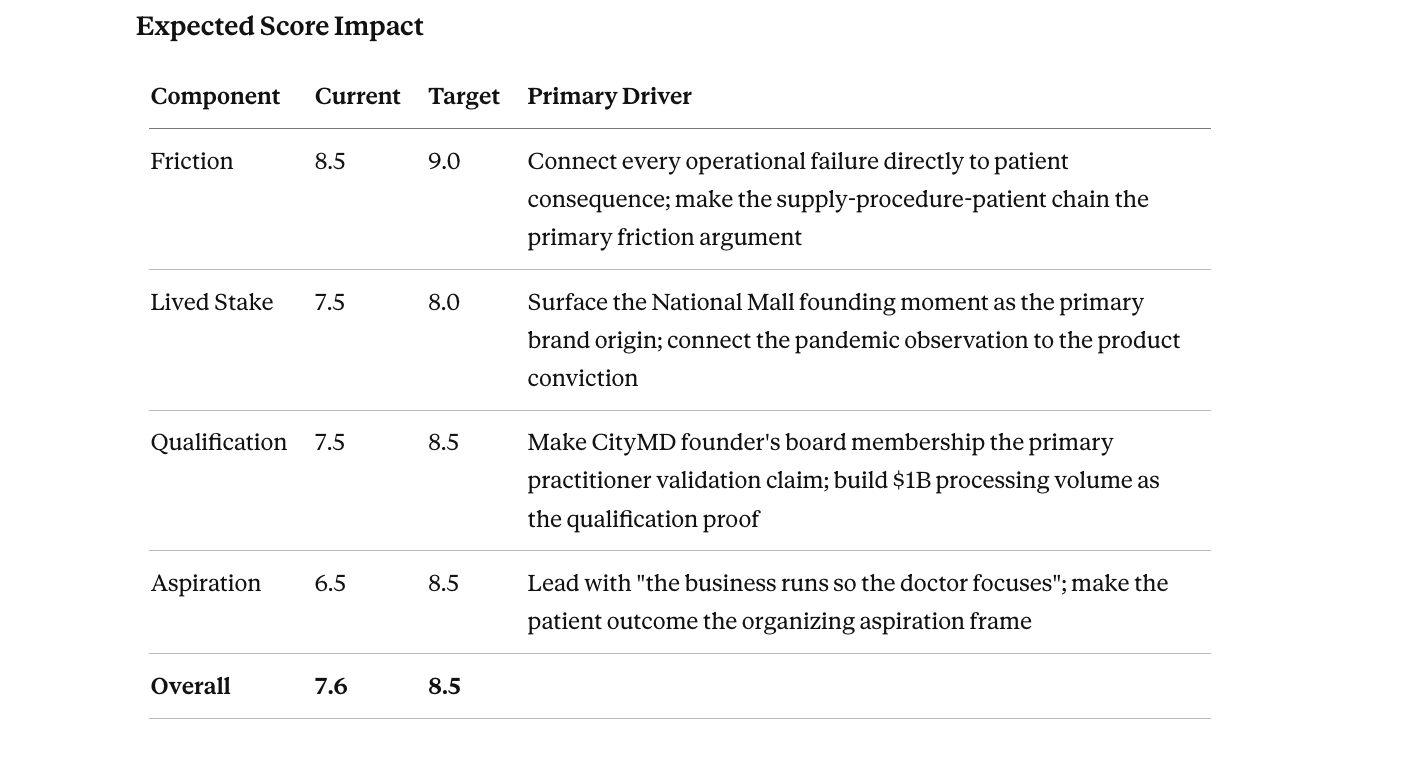
Three Strategies to Raise the Score
Strategy One: Connect the Operational Aspiration Directly to the Patient Outcome
Current state: The primary aspiration is “AI-native operating system for healthcare practices.” This names the platform and the customer. It does not name the consequence for the patient.
What to do: The most emotionally resonant version of Nitra’s aspiration is the one where the operational efficiency benefit is stated in terms of what the physician can now do with the time and attention the platform recovers. Not “faster procurement.” The surgeon who is not on hold with a distributor is with a patient.
Tactics:
Build “The Business Runs. The Doctor Focuses.” as the primary aspiration statement across all external communications. The argument: every hour a physician spends on administrative and operational tasks is an hour not spent on clinical care. The best medical practices in America are not the ones with the lowest administrative overhead. They are the ones where the operational infrastructure is good enough that it never interrupts the clinical practice. Nitra is building that infrastructure.
Strategy Two: Surface the National Mall Origin as the Brand’s Front Door
Current state: The four-hour National Mall walks during COVID are present in the founder story page and not visible in primary brand communications.
What to do: The founding moment is specific, visual, and historically grounded in the pandemic’s most visible revelation about healthcare infrastructure. Two founders walking for hours through Washington, D.C., during COVID, watching the country struggle with PPE shortages and vaccine logistics, and concluding that the operational infrastructure of healthcare was the specific problem worth solving: that is the kind of founding story that earns trust before the product is explained.
Tactics:
Build the National Mall origin into the primary brand narrative. The argument: the pandemic showed the whole country what a fragmented healthcare infrastructure looks like under pressure. The supply chain failures, the eligibility processing delays, the manual reconciliation that could not scale: these were operational failures, not clinical ones. We watched them happen and decided to build the operating system that prevents them.
Strategy Three: Make the Procurement Automation Aspiration Concrete and Specific
Current state: The founder’s story describes a world where a practice “anticipates supply needs from procedures, patient volume, and history.” This is the aspiration at its most operational and specific. It has not been made the primary external brand claim.
What to do: The embedded agentic commerce aspiration, where procurement becomes predictive rather than reactive, is the most specific and most differentiated claim Nitra can make. No bank, EHR, or practice management software company is making this claim in the healthcare market.
Tactics:
Build “Procurement That Runs Before You Think to Order” as the forward aspiration that leads product marketing for the procurement layer. The argument: the retina clinic that runs out of a critical lens two days before a scheduled procedure did not have bad planning. They had bad infrastructure. Nitra’s AI procurement layer knows the procedure schedule, current inventory, historical usage rates, and supplier lead times. It places the reorder before the shortage is possible. That is what the operating system for healthcare commerce looks like when it is fully embedded.
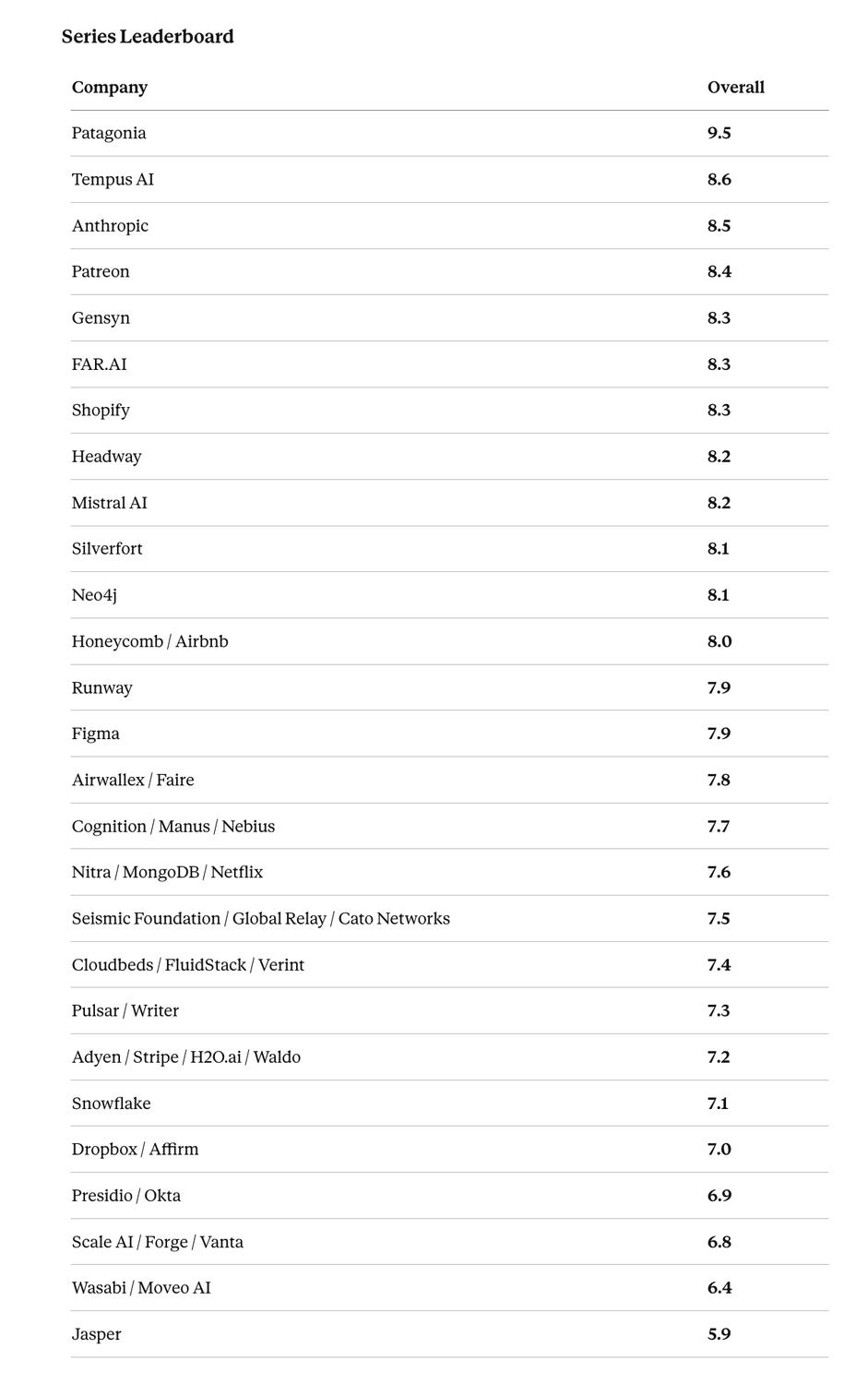
The comparison that most directly illuminates Nitra’s position is Headway, which this series scored at 8.2. Both companies are building infrastructure for a healthcare system with extraordinary clinical capabilities but fragmented operational and financial infrastructure. Headway is building the financial and administrative rails that connect insured patients to therapists. Nitra is building the financial and operational rails that connect practices to their suppliers, vendors, payroll systems, and patients.
Headway scores higher primarily because of the lived stake. Andrew Adams was the patient before he was the founder. He experienced the broken system firsthand and then spent two years manually working within it before building the software. Hwang and Chen experienced the healthcare operational problem through customer relationships at FiscalNote, which is a genuine and informative form of lived stake that earns 7.5 but not 9.5.
The second comparison is Verint, for which this series scored at 7.4. Both Nitra and Verint are companies building platforms for markets with fragmented operational infrastructure that are converging on AI as the coordination layer. Both have aspiration scores that reflect the difficulty of naming a world beyond the product category. Both have qualification scores built on commercial traction in enterprise accounts. Nitra scores slightly higher because the founding story is more specific and the patient-outcome connection is more emotionally resonant than the contact center-revenue center argument.
Nitra’s score of 7.6 reflects a company at an early-stage-to-growth inflection that has identified the right problem, built genuine commercial proof, and articulated an aspiration that has not yet been assembled as the consistent primary claim. The most important brand work available: connect the operational efficiency the platform delivers directly to the patient outcome that every physician actually came to medicine to protect.
All facts verified against primary sources, including Nitra’s official founder story page (nitra.com/resources/founder-story), the $187M financing press release (March 10, 2026), the original $62M seed round press release (August 23, 2022), Nitra’s LinkedIn company page, and Alejandro Cremades / DealMakers interview with Jonathan Chen.
This analysis is part of an ongoing series applying the Narrative Authenticity Framework to company and organization brands. Previous analyses include Patagonia, Anthropic, Airbnb, Netflix, Figma, Honeycomb, Stripe, Vanta, Okta, Writer, Jasper, Affirm, Shopify, Wasabi, Cato Networks, Nebius, Forge, Patreon, MongoDB, Tempus AI, Neo4j, Global Relay, Moveo AI, Mistral AI, Scale AI, Adyen, FAR.AI, Faire, FluidStack, Dropbox, Manus, Snowflake, H2O.ai, Seismic Foundation, Cognition, Waldo, Runway, Airwallex, Cloudbeds, Pulsar, Silverfort, Verint, Headway, Presidio, Gensyn, and others.
I am Tim Donovan, founder of SeekArgus and senior marketing and communications advisor at Enterra Solutions. I publish the SeekingAI newsletter on Substack for senior marketing executives at seekargus.substack.com.